Tag: Storytelling

  • THE STORY

    THE STORY

    Chapter One: Spread Kindness Today

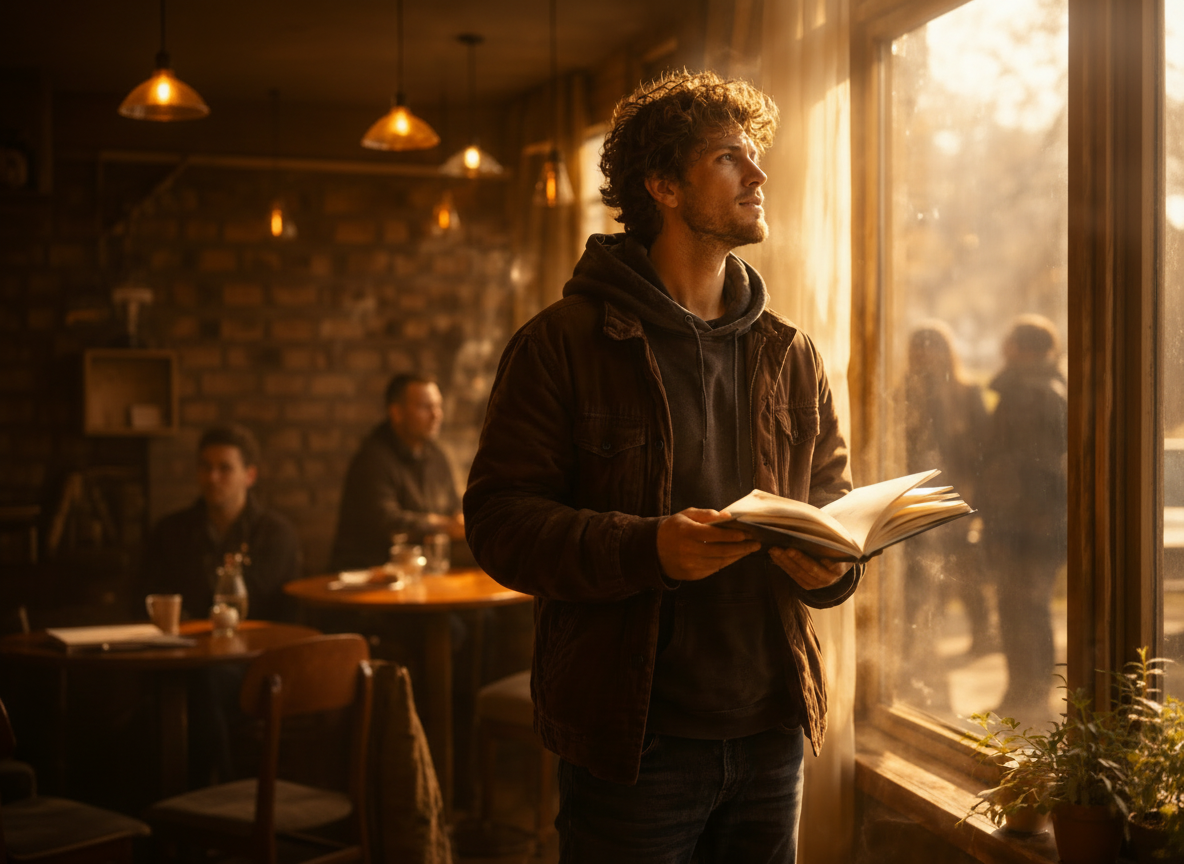
    Luca always chose the same seat in the corner cafe. It was tucked beneath a tall window where the morning light softened into a warm glow across his sketchbook. He liked the way the world moved on the other side of the glass. Drawing was his ritual. His anchor. His way of understanding the world without having to speak too loudly in it.

    He sketched the people outside the window. A woman adjusting her scarf. A teenager laughing into a phone. A man sitting alone on a bench, shoulders heavy, hands trembling slightly. Luca paused. Something about the man’s posture felt familiar. The quiet weight. The loneliness. The way someone can look like they are holding their breath through life.

    As Luca watched, the man tried to lift a heavy bag but struggled. People walked past without slowing down. Luca felt the old instinct to stay in his seat, to remain the observer rather than the participant. But creativity had taught him to notice things. To see what others missed. And once he saw it, he could not pretend he had not.

    He closed his sketchbook and stepped outside.

    Can I help you, he asked gently.

    The man nodded, relieved. Together they lifted the bag onto the bench. The man exhaled, offering a small, tired smile.

    As Luca stepped back, his sketchbook slipped from his coat pocket and fell open on the pavement. The man glanced down. His expression changed. The exhaustion in his eyes softened into something warm.

    This is beautiful, he whispered.

    Luca froze. No one had ever said that to him. Not once.

    He picked up the sketchbook with trembling hands. Something inside him shifted. He had helped a stranger, but the stranger had given him something he had not known he needed. Recognition. Connection. A moment of being seen.

    As he walked back into the cafe, he whispered to himself, Spread Kindness Today. 

    Not as a task. 

    As a truth.

    Creativity had opened his eyes to someone who needed help. 

    Kindness had opened a door he did not yet understand.

    And that door was the beginning of his journey.

    Chapter Two: Be the Reason Someone Smiles 

    The next morning Luca returned to the cafe with a strange mix of hope and fear swirling in his chest. He kept replaying the stranger’s reaction to his sketch. The softness in the man’s eyes. The way his shoulders had eased. The quiet warmth in his voice.

    It had been such a small moment, yet it felt enormous. 

    Someone had smiled because of something Luca created. 

    Someone had felt lighter because of him.

    But doubt crept in quickly. 

    What if the man had only said it to be polite. 

    What if Luca had imagined the meaning. 

    What if his work was nothing special at all.

    He tried to draw, but his hand trembled. The lines felt stiff. Forced. Empty.


    Then the bell above the cafe door chimed.

    The stranger walked in.

    He spotted Luca immediately and approached with a gentle steadiness.

    I hope you do not mind, he said, but I wanted to thank you again. Yesterday meant more to me than you know.

    Luca blinked, unsure how to respond.

    Your drawing reminded me that there is still beauty in the world, the man continued. I have been carrying a heavy season, and your art gave me a moment of peace. You did that. You were the reason I smiled yesterday.

    The words hit Luca with unexpected force. 

    Not flattery. 

    Not politeness. 

    Truth.

    The man sat down across from him.

    You have a gift, he said. Not just for drawing, but for seeing people. That is rare. Do not hide it.

    Luca felt something inside him loosen. 

    A knot he had carried for years. 

    A door opening.

    Be the Reason Someone Smiles, he thought. 

    Maybe creativity could do that. 

    Maybe he could do that. 

    Maybe he already had.

    For the first time, he wondered if his art had a place in the world beyond his sketchbook.

    And that possibility scared him. 

    But it also lit something bright inside him.

    Chapter Three: Join the Conversation 

    The man stayed for coffee. 

    Tell me about your work, he said. 

    Tell me why you draw.

    Luca hesitated. Sharing his art was one thing. Sharing himself was another. But something about the man felt safe. So he opened the sketchbook and let the pages turn.

    They talked for nearly an hour. About creativity. About loneliness. About the courage it takes to make something and let it be seen. Luca felt himself opening in ways he had not expected. He felt part of something larger than himself. A conversation he had always wanted to join but never believed he belonged in.

    When the man left, Luca felt changed. 

    He felt invited. 

    He felt called.

    That night he posted one of his sketches online with the caption, Join the Conversation. It was the first time he had ever shared his work publicly.

    Some people loved it. 

    One person criticized it. 

    Luca felt both reactions deeply.

    But he kept going. 

    Because connection always comes with risk. 

    And creativity always asks for courage.

    Chapter Four: Share Your Story

    The next day the man returned to the café again. This time his expression carried a quiet seriousness.

    May I ask you something, he said as he sat down. 

    Not about your technique. Not about your style. 

    About you.

    Luca nodded, unsure where this was going.

    Why do you hide your work, he asked. 

    What are you afraid people will see?

    The question landed like a stone dropped into deep water. 

    It was not about art. 

    It was about him.

    Luca felt his throat tighten. He looked down at his hands, then at the sketchbook resting between them.

    I hide it because it feels safer, he said. 

    If no one sees it, no one can misunderstand it. 

    Or dismiss it. 

    Or dismiss me.

    The stranger listened with a stillness that felt like respect.

    Luca continued, I draw people because I know what it feels like to be unseen. I draw them because I want to understand them. I draw them because I hope someone will understand me too. But sharing that feels like stepping into the light without armor.

    The man nodded slowly. 

    Thank you for telling me that, he said. 

    I think you deserve to know who you have been talking to.

    He introduced himself. 

    A well known artist. 

    A mentor to many. 

    A person whose work Luca had admired for years without ever imagining he would meet him.

    Luca felt the world tilt. 

    Not because of the fame. 

    Not because of the opportunity. 

    But because someone he respected had seen him clearly and believed in him anyway.

    The man smiled. 

    Your work has something real in it. Something honest. I would like to help you share it with the world, if you are willing.

    Luca felt fear rise, but something stronger rose with it. 

    Courage. 

    Possibility. 

    A sense of belonging he had never felt before.

    In the weeks that followed, Luca began sharing his work publicly. He posted sketches, stories, and reflections. He invited others to share their own creative journeys. People responded with honesty and gratitude. A community formed around his courage.

    He realized something important. 

    Creativity is not about perfection. It is about connection. 

    Kindness is not about grand gestures. It is about noticing. 

    Stories are not meant to be locked away. They are meant to be shared so others can find their way.

    His final message to his growing community read:

    Share Your Story. 

    Someone out there needs the light you carry.

    And people did. 

    They shared their work. 

    They shared their fears. 

    They shared their hopes.

    Luca had become the reason someone smiled. 

    And in doing so, he had found his own place in the world.

    Cedar & Shore Studio Reflection

    Kindness, Connection, and the Creative Life

    Luca’s story reminds us that creativity is not only about what we make. It is about how we move through the world. His journey begins with a simple act of noticing, the kind of quiet awareness that artists carry like a second heartbeat. Creativity sharpens our eyes to the small moments that others pass by. It teaches us to see people, to sense the weight they carry, and to respond with presence.

    Kindness becomes the first brushstroke in Luca’s transformation. Not a performance, not a grand gesture, but a choice to step out of the corner seat and into someone else’s moment. That choice opens a door he did not expect. The stranger’s smile becomes a mirror, reflecting a truth he had never allowed himself to believe. His work matters. His presence matters. He matters.

    Connection grows from that spark. A conversation begins. A sketchbook becomes a bridge. Two people sit across from each other and share the kind of honesty that creativity often protects. This is the heart of a creative lifestyle. It is not isolation. It is not perfection. It is the courage to let your inner world meet someone else’s.

    When Luca finally shares his work with others, he discovers what many artists learn only after years of hiding. Stories create community. Vulnerability invites belonging. When we share what is real, people gather. They lean in. They recognize themselves in the lines and shadows of our work.

    At Cedar and Shore Studio, we believe creativity is a way of living that honors these moments. Kindness, connection, and storytelling are not separate from the creative process. They are the foundation of it. They shape the way we see, the way we create, and the way we show up for others.

    Luca’s story is a reminder that every creative act carries light. When we choose to share that light, even in small ways, we make room for others to do the same.

    Kindness, Connection, and Creative Life Research

    Creativity, kindness, and human connection are not separate lanes. Research suggests they reinforce one another in powerful ways and shape a sustainable creative life.

    Creatives move through the world with heightened attention. They notice details, moods, gestures, and stories that others pass by. This sensitivity is not only the foundation of artistic work. It is also the foundation of kindness and connection.

    This report explores how people living creative lifestyles can practice kindness, build meaningful connection, and contribute to a more compassionate world. It draws from research in creativity studies, social psychology, prosocial behavior, and community arts practice.

    The Creative Lifestyle as a Foundation for Kindness

    Creatives tend to engage deeply with perception, emotion, and meaning. Research shows that:

    This heightened awareness positions creatives to practice a form of kindness rooted in noticing the quiet, attentive kind that sees what others overlook.

    How creatives naturally express kindness

    • Offering thoughtful recognition 
    • Creating welcoming spaces for others to share 
    • Using their skills to support community needs 
    • Encouraging others through process‑focused feedback 
    • Reflecting back beauty, meaning, or dignity through their work

    These acts are small, but research shows that small acts of kindness have outsized impact on both giver and receiver. 

    https://www.creativeboom.com

    Connection as a Creative Practice

    Connection is not only social. It is creative. It is the act of building bridges between inner worlds.

    Research shows that:

    How creatives build connection

    • Sharing work with context, not just output 
    • Listening with the same depth they use to observe 
    • Collaborating with intention and respect 
    • Hosting small, consistent creative communities 
    • Inviting others into dialogue rather than performance

    Connection becomes a creative act in itself, one that enriches both the artist and the people around them.

    How Kindness and Connection Benefit the Creative Person

    This is not self‑sacrifice. It is nourishment.

    Research suggests that:

    Benefits for creatives

    • A deeper sense of purpose 
    • More sustainable motivation 
    • Broader creative vocabulary 
    • Emotional resilience through community 
    • A sense of belonging that fuels courage

    Kindness and connection are not distractions from creative work. They are catalysts.

    How Creative Kindness Makes the World Better

    Creatives influence culture, mood, and meaning. Their kindness ripples outward.

    Research shows that:

    Creative kindness in action

    • Humanizing public spaces 
    • Elevating community stories 
    • Modeling generosity in creative culture 
    • Inspiring others to act with compassion 
    • Creating shared experiences that bring people together

    Creatives do not need to change the whole world. They change the room they are in. And that is how the world changes.

    Reflection for Creative Readers

    Reflection Questions for Creative Readers

    • Where can I offer one small act of creative kindness this week 
    • How can I share my work in a way that invites conversation 
    • What story or skill can I offer that might help someone feel seen 
    • How can I build or join a small creative community 
    • What ripple effect do I hope my creative life will have

  • The Traveler Who Wore the Hours

    The Traveler Who Wore the Hours

    There are stories older than memory.

    Stories that move like tides beneath the surface of a life.

    This is one of them.

    The Traveler Who Wore the Hours

    They say the traveler arrived without a sound. 

    Not born. Not summoned. Simply there. 

    Standing at the edge of a world already in motion.

    No name. 

    No past. 

    Only a cloak woven from the threads of every hour that had ever been lived.

    The first thing the traveler learned was weight. 

    Not the weight of the body, 

    but the weight of being. 

    The strange gravity of existing in a place where moments cling like wet leaves.

    Time did not welcome them. 

    It tested them. 

    Bent them. 

    Taught them how to ache.

    The traveler walked.

    Through childhoods that weren’t theirs. 

    Through heartbreaks that tasted familiar. 

    Through victories that felt borrowed. 

    Through years that passed like storms, 

    and others that drifted by like dust.

    Everywhere they went, they wore a different face. 

    A different purpose. 

    A different version of themselves.

    A healer in one century. 

    A wanderer in the next. 

    A friend. 

    A stranger. 

    A ghost. 

    A memory.

    And with each life, the traveler learned something new. 

    How joy can bloom in the smallest cracks. 

    How fear can hollow out the strongest heart. 

    How shame can cling longer than any shadow. 

    How love can rewrite the laws of time itself.

    But the traveler also learned this: 

    Everything they learned eventually slipped away.

    Wisdom arrived like sunrise. 

    Warm. Golden. Promising. 

    And then, just when the traveler believed they finally understood the shape of the world, 

    wisdom dissolved like mist.

    Because wisdom, too, was only passing through.

    The traveler began to see the truth.

    Time was not a river. 

    It was a hall of mirrors. 

    Every reflection a life. 

    Every life a lesson. 

    Every lesson a temporary shelter.

    And the traveler 

    was simply the one who walked between them.

    They stopped trying to hold on. 

    Stopped trying to make sense of the pattern. 

    Instead, they began to listen. 

    To the silence between moments. 

    To the ache beneath joy. 

    To the truth that hides inside forgetting.

    They understood that every life was a question. 

    And every answer was incomplete.

    One day, after centuries or seconds 

    (the traveler could no longer tell), 

    they reached a quiet place where the world thinned. 

    A seam in reality. 

    A doorway back to the nothing from which they came.

    They paused.

    Behind them lay every life they had ever lived. 

    Every face. Every mistake. Every triumph. 

    Every moment they thought would matter forever 

    but now shimmered like distant constellations.

    Ahead of them lay the unknown.

    The traveler felt no fear. 

    No sorrow. 

    Only a strange, tender ache. 

    The ache of having been human for a while.

    They turned once more to the lives behind them. 

    Not to reclaim them. 

    But to honor them.

    And before stepping through, 

    the traveler whispered a final truth into the wind:

    “We feel deeply because we forget. 

    We forget because we must move forward. 

    And we move forward because the story is never finished.”

    Then, as quietly as they had arrived, 

    the traveler vanished.

    But somewhere 

    in a life not yet lived, 

    in a moment not yet born, 

    a new traveler will open their eyes. 

    Feel the weight of time settle on their shoulders. 

    And begin the journey again.

    Because the cycle continues. 

    Because the universe remembers. 

    Because every soul is a traveler. 

    And every traveler is searching for the timeline 

    where they finally feel at home,

    If this story resonated with you, I share more mythic short stories, poems, and behind‑the‑scenes moments on my Facebook page. You’re welcome to join me there and follow along as new pieces unfold.
    Find more stories here: https://www.facebook.com/cedarshorestudio


    If this story meant something to you, feel free to share it using the social buttons below. Your voice helps these stories find the people who need them.

  • The Weight of Water, The Warmth of Dawn

    The Weight of Water, The Warmth of Dawn

    To the ones who carry their storms in silence. To the ones who rise each morning and step into the forest anyway. May the river teach you, the light warm you, and the small companions along the way remind you that you are never walking alone.

    CHAPTER ONE

    You Are Not Alone

    A narrow forest trail winds between tall trees, soft light filtering through the canopy and guiding the way forward.

    The dream woke him before dawn.

    He lay still inside the tent, breath unsteady, the nylon walls faintly glowing with the first hints of morning. The forest around him was silent except for the distant rush of the Elwha. The dream itself was already fading, slipping away like mist, but something it stirred remained. A memory he could not name. A feeling he could not shake.

    It settled in his chest with a familiar weight. Not sharp. Not clear. Just heavy. A quiet ache that lived beneath his ribs.

    He closed his eyes, hoping the feeling would ease, but it stayed. It always stayed.

    The air inside the tent felt close. He pulled the zipper open and stepped into the cold morning. Mist drifted between the trees, soft and pale. The campsite was still, the fire pit dark, the world holding its breath. He wrapped his arms around himself, trying to steady the tremor in his chest.

    He thought about crawling back into the tent. He almost did. The weight inside him urged him to stay still, to avoid the trail, to avoid whatever the dream had stirred awake. But the feeling pressed harder, a quiet reminder of everything he had been trying not to feel.

    A sharp call broke the silence.

    He looked up.

    A Steller’s Jay perched on a low branch near the edge of the campsite. Its feathers shimmered with deep blues and charcoal grays. It tilted its head, watching him with attention that felt too focused to be accidental. For a moment, neither of them moved.

    The jay hopped to another branch, then another, each one closer to the trailhead. It paused and looked back at him, as if waiting.

    He let out a slow breath. The forest felt heavy, but the bird’s presence steadied him in a way he could not explain. He stepped toward the trail. The jay fluttered ahead, guiding him deeper into the trees.

    The path was soft with fallen needles. Fog curled around the trunks of ancient cedars. His boots left dark impressions in the earth, trailing behind him like questions. He walked slowly at first, unsure if he wanted to continue, unsure if he could. The feeling from the dream lingered at the edges of his awareness, a shadow he could not shake.

    The jay landed on a branch above him. It let out a soft call, a sound that echoed gently through the trees. He felt something shift inside him. Not hope. Not yet. Just a small sense of presence. A reminder that he was not entirely alone in this quiet, heavy place.

    He kept walking.

    The forest did not change. The fog did not lift. But the path felt different now. Each step carried a little more intention. A little more breath. A little more willingness to move forward, even if he did not know where the trail would lead.

    The jay flew ahead, disappearing into the mist. He followed.

    And for the first time that morning, the weight in his chest loosened, just enough for him to take another step.

    CHAPTER TWO

    Take a Step Toward Healing

    A hand gently brushes through tall grass while walking forward, the blades bending softly in the morning light.

    The trail grew rougher as he moved deeper into the forest. The soft bed of needles gave way to uneven ground, scattered with roots and stones slick with morning moisture. Fog drifted low across the path, curling around his boots as if trying to slow him. He stepped carefully, but even careful steps slipped now and then.

    The feeling from the dream stayed with him. Not sharp. Not clear. Just a weight that pressed against his ribs with every breath. He tried to shake it off, but it clung to him like the mist.

    The Steller’s Jay appeared again.

    It landed on a branch just ahead, feathers bright against the muted greens and grays of the forest. It watched him with that same steady attention, then hopped to another branch farther up the trail. He followed, grateful for the small sense of direction the bird offered.

    The trail steepened. His legs burned as he climbed, each step heavier than the last. He paused to catch his breath, leaning his hand against the rough bark of a cedar. The forest was silent except for the distant rush of the river. The sound felt closer now, deeper and more insistent.

    The jay called once, a sharp note that echoed through the trees. He looked up. The bird waited on a branch higher along the ridge, head tilted as if checking on him. He pushed himself upright and continued.

    The climb grew steeper still. Roots twisted across the ground like old scars. He stumbled once, catching himself on his hands. Dirt clung to his palms. His breath came in short, uneven pulls. The feeling in his chest tightened, rising with the strain of the climb.

    He wanted to stop. He wanted to turn back. The weight inside him whispered that he was foolish to keep going, that the trail was too much, that he was too tired.

    The jay fluttered down to a lower branch, closer than before. It looked at him, feathers ruffling in the cool air. Something in its presence steadied him. Not encouragement. Not guidance. Just a quiet reminder that he was not alone on this path.

    He pushed forward.

    The ridge leveled out at last, opening into a narrow stretch of trail that curved between moss-covered boulders. The sound of the river grew louder, a deep and constant roar. He followed the noise until the trees parted and the Elwha came into view.

    The river was swollen from snowmelt. Its surface churning with white foam and cold blue water. The current moved fast, powerful and unyielding. Mist rose from the surface, drifting across the rocks like breath.

    He stepped closer to the bank. The air was colder here. The sound of the water filled the space around him, drowning out everything else. He felt the weight in his chest tighten again, rising with the memory the dream had stirred. Not a picture. Not a moment. Just the ache.

    The jay landed on a branch above the river, watching him. It did not move. It did not call. It simply waited.

    He looked at the water. The trail continued on the other side. There was no bridge. No easy crossing. Only the river, wide and restless.

    He felt a tremor in his hands.

    The river was a test. He knew it the moment he saw it. Not a test of strength. Not a test of skill. A test of willingness. A test of whether he could keep moving even when everything inside him wanted to stop.

    He stepped toward the water.

    The cold air stung his skin. The roar of the current filled his ears. The feeling in his chest pressed harder, rising like a tide.

    He took a breath.

    And stepped into the river.

    CHAPTER THREE

    Find Your Light

    Soft morning light filters through tall cedar trees, illuminating drifting mist and creating gentle beams across the forest path.

    The cold hit him the moment he stepped into the river.

    It wrapped around his legs like a shock, stealing his breath. The Elwha surged past him in a restless rush of pale blue water, swollen from snowmelt and moving with a force he had underestimated. He took another step, then another, feeling for the stones beneath the surface. They were smooth and slick, shifting under his weight.

    The current pressed against him. His balance wavered.

    He tried to steady himself, but the river pushed harder. His foot slipped on a hidden stone. His body lurched sideways. For a heartbeat he thought he could recover, but the current caught him fully and pulled him off his feet.

    The world tilted.

    Cold water rushed over him.

    The river swept him downstream.

    He tumbled through the current, arms reaching for anything solid. The roar of the water filled his ears. His breath tore from him in short, panicked bursts. The cold sank deep into his bones. He felt the river’s strength, not cruel but overwhelming, a force that did not care whether he stood or fell.

    The feeling rose with it.

    The memory the dream had stirred surged back, not as images but as emotion. A wave of loss. A moment slipping away. A sense of being left behind. The ache of not being enough. It crashed through him with the same force as the river, pulling him under, filling his chest with a heaviness that felt impossible to carry.

    He reached for the riverbank.

    His hand found a rock. His fingers clung to it. He pulled himself toward the shore, fighting the current with what strength he had left. The water resisted, but he pushed through it, inch by inch, until his knees struck the gravel at the edge.

    He dragged himself onto the bank and collapsed.

    Water streamed from his clothes. His breath came in ragged pulls. His hands trembled uncontrollably. The cold clung to him, but the feeling inside him was colder still. The memory pressed against him, heavy and unspoken, a weight he had carried far too long.

    A soft flutter broke the roar of the river.

    He looked up.

    The Steller’s Jay had landed on a branch above him. Its feathers glowed with deep blue in the muted light. It watched him with a steady, quiet presence, as if it had been waiting for this moment. It did not call. It did not move. It simply stayed.

    He closed his eyes.

    For the first time, he did not push the feeling away. He let it rise. He let it fill him. The ache. The regret. The loneliness. The sense of something lost. It washed through him like the river, overwhelming but honest. His breath shook. His chest tightened. Tears mixed with the river water on his face.

    He sat with it.

    He breathed through it.

    The jay remained above him, silent and steady, a witness to the moment he had avoided for so long.

    Slowly, the weight inside him shifted. Not gone. Not healed. But it loosened. The feeling that had pressed so hard against his ribs softened, leaving space for air to move again.

    He pushed himself upright.

    The forest around him was quiet. The fog drifted through the trees in thin strands. The jay fluttered to a nearby branch, guiding him forward. He followed; legs unsteady but moving.

    The trail led him to a small clearing.

    The fog thinned as he stepped into it. Above him, the canopy opened just enough for a single beam of sunlight to break through. Warm and golden, it fell across the moss-covered ground in a gentle arc. Dust and moisture drifted through the light, turning it into something almost tangible.

    He stepped into the beam.

    The warmth settled across his shoulders and down his spine. It did not erase the heaviness he carried, but it softened it. It made space around it. It made space inside him.

    He closed his eyes.

    For a moment, he let himself imagine that the light was reaching into the places he had kept hidden. The places he had convinced himself were too dark to be seen. He felt something loosen again, a knot he had carried for so long that he had forgotten what it felt like to breathe without it.

    He opened his eyes.

    The clearing felt different now. Not brighter. Not louder. Just more open. As if it had been waiting for him.

    He took a slow breath and let it out. The air tasted clean. The light held him gently, asking nothing, offering everything.

    He did not know what waited beyond the trees. He did not know how long the path would be or what he would face when he reached the edge of the forest.

    But he knew this.

    He wanted to keep going.

    He wanted to see where the light would lead.

    CHAPTER FOUR

    Believe in a Brighter Tomorrow

    Golden sunrise light spreads across a quiet beach, reflecting on wet sand as gentle waves roll toward shore.

    The forest thinned as he continued forward. The trees grew farther apart, letting in more light with each step. The fog drifted higher, rising into the branches instead of clinging to the ground. His clothes were still damp from the river, but the sunlight filtering through the canopy warmed his shoulders as he walked.

    The trail was still rough, but it no longer felt impossible. His legs ached, yet the ache felt earned. Each step carried a steadiness he had not felt before. The feeling that had pressed so heavily against his ribs was still there, but it no longer controlled his breath. It moved with him instead of against him.

    The distant sound of waves reached him through the trees.

    He paused, listening. The rhythm was soft at first, almost hidden beneath the rustle of branches. A slow pull. A gentle break. The familiar cadence of the shoreline. He felt something inside him respond to it, a quiet recognition that he was nearing the end of the forest and the beginning of something new.

    The Steller’s Jay appeared again.

    It landed on a branch just ahead, feathers bright in the growing light. It watched him with the same steady attention it had shown since the campsite. Then it fluttered forward, guiding him toward the sound of the sea.

    He followed.

    The trees opened at last, releasing him onto a stretch of beach washed in early morning gold. The Salish Sea stretched wide before him, its surface shimmering with soft light. The horizon glowed with a warm brightness that spread across the water in a gentle path. The air tasted of salt and cold stone. The world felt open in a way the forest never had.

    He stood still, letting the scene settle around him. The waves rolled in with a calm persistence, each one rising and falling with a rhythm that felt ancient and patient. He felt the echo of that rhythm inside his chest, steady and quiet.

    The jay landed on a piece of driftwood near the water. It looked at him one last time, head tilted, feathers ruffling in the breeze. For a moment, they simply regarded each other. Then the bird lifted into the air, wings catching the light as it rose above the shoreline. It circled once, then disappeared into the trees behind him.

    He watched it go.

    A soft warmth spread through him. Not joy. Not certainty. Something quieter. Something steadier. A sense that he had been guided through something difficult and had reached a place where he could breathe again.

    He stepped toward the water.

    The waves stretched their foam across the dark sand, touching the tips of his boots. The cold seeped through the leather, grounding him. He took a slow breath, filling his lungs with the clean, bracing air. The feeling inside him shifted again, loosening in a way he had not expected.

    He looked out at the horizon.

    The light on the water shimmered gently, a quiet invitation. He felt the memory the dream had stirred, but it no longer pressed against him with the same weight. It was still there, still part of him, but it no longer defined the shape of his breath.

    He understood something then.

    Healing was not a single moment. It was not the clearing. It was not the river. It was not the sunlight or the jay or the shoreline. It was the choice to keep moving, even when the path was rough. It was the willingness to feel what he had avoided. It was the quiet courage to step forward again.

    He took another breath.

    The air tasted of salt and possibility.

    He did not know what tomorrow would bring. He did not know how many steps the journey ahead would require. But he knew this.

    He believed, quietly and honestly, that tomorrow could be brighter than today.

    And that belief, fragile and new, was enough to begin again.

    Creativity and the Quiet Weight We Carry

    Exploring the Emotional Landscape Behind the Creative Life

    A person stands at the edge of a misty forest clearing at dawn, soft light filtering through tall cedar trees as fog drifts across the ground, holding a sketchbook or camera at their side.

    There is a long, complicated history between creativity and mental health. Many artists, writers, musicians, and makers have spoken openly about the storms they carry, and research reflects what many of us already feel in our bones.

    Studies have found that people who identify as creative often experience higher rates of depression and anxiety compared to the general population. Some research suggests that creative individuals may be more sensitive to emotional shifts, more attuned to subtle changes in their inner world, and more likely to process life through imagination and introspection. These traits can be gifts, but they can also make the weight of difficult emotions feel heavier.

    Creativity becomes both a refuge and a mirror.

    A place to express what cannot be spoken.

    A way to turn pain into shape, color, story, or sound.

    A way to keep moving when the path feels unclear.

    But it is important to remember this:

    Struggling does not make you broken.

    Feeling deeply does not make you weak.

    And carrying a storm does not mean you walk alone.

    Many people who create do so because they feel the world intensely. They notice the quiet things. They sense the undercurrents. They see beauty and sorrow in the same breath. This sensitivity is not a flaw. It is a form of strength, even when it feels overwhelming.

    If you are moving through a difficult season, you are not alone.

    If the weight feels heavy, you are not failing.

    If you are still taking steps, even small ones, you are already showing courage.

    Healing is not a straight line.

    It is a trail through fog, a river that tests you, a clearing where light finally reaches your shoulders.

    It is the quiet decision to keep going, even when you don’t know what tomorrow will bring.

    Wherever you are on your journey, you may find moments of warmth, moments of clarity, and moments of connection. And may you remember that your story matters, your voice matters, and your presence in this world matters more than you know.

    A brighter tomorrow is possible.

    One step at a time.

    An open journal and steaming mug of tea sit on a wooden desk near a window, with soft morning light illuminating nearby plants and a misty forest beyond. The scene feels quiet and restorative.

    Caring for Your Mind While Creating

    Creativity and mental health often move together in ways that are both beautiful and challenging. Many people who create feel the world deeply. They notice the quiet details, sense emotional shifts, and carry a sensitivity that fuels their art. That same sensitivity can also make difficult seasons feel heavier.

    While there is no single path through struggle, there are practices that can support your well‑being and help you keep moving toward a brighter tomorrow. These are not cures or quick fixes. They are gentle, steady ways to care for yourself while honoring the depth of your inner world.

    A simple bowl of fresh fruit and a glass of water sit on a wooden table in soft morning light, with a linen cloth and greenery adding a calm, nourishing atmosphere.

    1. Nourish Your Body with Consistent, Supportive Nutrition

    Food does not replace professional care, but it can support your overall well‑being. Research suggests that balanced nutrition may help stabilize mood and energy levels. Many people find benefit in:

    • eating regular meals
    • incorporating fruits and vegetables
    • choosing whole grains
    • including sources of protein
    • staying hydrated           

    These habits can help support your body during emotionally demanding times.

    For more information on nutrition and mental health, visit:

    Evidence‑based, updated every five years, and focused on practical healthy eating patterns.
    Link: https://www.dietaryguidelines.gov

    A person walks along a sunlit forest trail at a relaxed pace, surrounded by tall trees, ferns, and warm golden light.

    2. Move Your Body in Ways That Feel Good

    Exercise is often linked with improved mood and reduced stress. This does not need to be intense or structured. It can be:

    • a slow walk through your neighborhood
    • stretching in the morning
    • dancing in your living room
    • a gentle bike ride
    • tending a garden


    Movement helps release tension and reconnects you with your physical self, especially when your mind feels heavy.

    For general information on exercise and well‑being, explore:

    Link: https://health.gov/moveyourway

    A quiet forest clearing with soft morning light filtering through tall evergreens. Moss-covered logs, ferns, and gentle mist create a calm, grounding atmosphere. A narrow path winds through the trees, inviting slow exploration and connection with the natural world. Muted tones, cinematic light, Pacific Northwest mood

    3. Spend Time in Nature

    Nature has a way of grounding us. Studies have shown that time outdoors can reduce stress, improve focus, and support emotional balance. Even a few minutes outside can make a difference.

    You might try:

    • forest bathing
    • sitting beside a river
    • walking a familiar trail
    • listening to birds
    • watching the tide roll in

    The natural world offers a quiet reminder that change is constant and renewal is possible.

    For more on nature and mental health, visit:

    Link: How Nature Can Improve Your Mental Health

    An open sketchbook and scattered art materials sit on a sunlit table, with soft natural light creating gentle shadows and a calm, creative atmosphere.

    4. Create Without Expectation

    Creativity itself can be a form of care. Many people use creative expression to process emotions, reduce stress, or find meaning in difficult moments. You do not need to produce something perfect. You do not need to share it.

    You can:

    • write a few lines in a notebook
    • sketch shapes or colors
    • take a photograph of morning light
    • craft something with your hands
    • play with sound, texture, or movement

    Let creativity be a companion, not a performance.

    For research on creativity and mental health, explore:

    Link: 22 Practices to Cultivate & Nurture Creativity

    Two people sit together on a wooden bench in a quiet forest clearing, soft light filtering through the trees as they talk in a calm, supportive way.

    5. Seek Support When You Need It

    Reaching out is an act of strength. If you are struggling, talking with someone you trust can make a meaningful difference. This might be:

    • a friend
    • a family member
    • a counselor
    • a therapist
    • a support group

    Professional support can offer tools, perspective, and care that you do not have to find alone.

    For general mental health information and support resources, visit:

    Link: https://mhanational.org/finding-help

    If you ever feel overwhelmed or unsafe, connecting with someone immediately is important. You deserve support, and you deserve to be heard.

    A soft beam of light falls across a quiet forest path, creating a calm, reflective atmosphere that feels like a gentle closing moment.

    A Final Note

    Your mind is not your enemy.

    Your sensitivity is not a flaw.

    Your creativity is not a burden.

    You are allowed to rest.

    You are allowed to ask for help.

    You are allowed to hope for something better.

    Healing is a journey, not a destination.

    And every small step you take is a step toward the warmth of your own dawn.

  • Welcome to Cedar & Shore Studio: A Creative Journey Begins

    Welcome to Cedar & Shore Studio: A Creative Journey Begins

    A horizon for stories, identity, and connection

    Hello and welcome. I’m Tom Buscher, founder and creative director of Cedar & Shore Studio, a creative space rooted in Sequim, Washington and shaped by the land and light of the Olympic Peninsula. This studio brings together everything I value: honest storytelling, thoughtful design, and work that honors people and place. After years of refining my craft and learning from the community around me, I am excited to share this space with you. At the same time, this journal marks the beginning of a new chapter for Cedar & Shore Studio.

    Whether you are a longtime local, a fellow creative, or someone discovering this region for the first time, I am glad you are here. In fact, this space was built with intention, and it was built for you.

    Photography and Branding in Sequim

    Cedar & Shore Studio represents more than a single service. It is a place where art, identity, and clarity come together. I offer Sequim photography and branding, web design, creative direction, and writing that helps people and businesses tell their stories with confidence. Each service supports the others. As a result, clients receive a complete creative ecosystem that feels cohesive and intentional.

    Natural Light Photography on the Olympic Peninsula

    Photography sits at the heart of Cedar & Shore Studio. I focus on natural light portraiture, lifestyle sessions, and nature‑inspired imagery. I want every image to feel alive, warm, and honest. In addition, I aim to create a calm and welcoming experience during every session. Many clients tell me they feel at ease in front of the camera for the first time. That sense of comfort shapes the work we create together.

    Branding and Visual Identity Design in Sequim

    Branding is more than a logo. It is the story you tell, the feeling you create, and the way people remember you. I help clients build brand identities that feel grounded and true. This includes color palettes, typography, messaging, and visual direction. Furthermore, I guide clients through the process with clarity and care. As a result, they walk away with a brand that feels cohesive, meaningful, and ready to grow.

    Web Design for Small Businesses and Creatives

    Your website is often the first place people meet your work. I design clean, intentional websites that are easy to navigate and built to grow with you. I focus on clarity, accessibility, and a sense of place. In addition, I build sites that support long‑term goals, whether you are a small business, a creative, or a community organization. This approach helps clients feel confident as they share their work with the world.

    Copywriting and SEO for Clear, Human Storytelling

    Words matter. They shape how people understand your work and how they find you online. I write copy that is simple, clear, and rooted in your story. I also use SEO best practices to help your site reach the people who need it most. This includes keyword research, meta descriptions, alt text, and content structure. In short, I help clients speak in a voice that feels human and true.

    Community Building Through Creative Connection

    Cedar & Shore Studio is also a community space. I host a growing group for writers, artists, and photographers who want to share their work and connect with others. Creativity thrives in community. Therefore, I want this studio to be a place where people feel supported, inspired, and encouraged to grow.

    Why I Create on the Olympic Peninsula

    Photography and storytelling have always helped me understand the world. They help me slow down, pay attention, and celebrate connection. I believe in work that honors people and place. Above all, I want to create images and stories that feel real and rooted.

    As a Sequim local and multimedia creative, I bring both skill and care to every project. Curiosity shapes my process. Growth guides my decisions. I continue to learn, experiment, and refine my craft. Furthermore, I am grateful for the people who trust me with their stories, and I am excited to share that journey with you.

    What You’ll Find in the Cedar & Shore Journal

    This journal is a place for stories, learning, and connection. It will grow over time, and it will reflect the many parts of Cedar & Shore Studio. Here is what you can expect:

    • Behind‑the‑scenes stories from sessions and creative projects
    • Tips and resources for clients and fellow creatives
    • Educational content on photography, branding, and web design
    • Local features about the Olympic Peninsula and its creative community
    • Creative writing inspired by photography and place‑rooted storytelling
    • Updates on print offerings, studio news, and upcoming events

    In addition, I will share insights from my own creative journey. Ultimately, this journal is meant to be welcoming, inspiring, and clear. It should feel like an extension of the experience I offer in every collaboration.

    The Value of Cedar & Shore Studio

    Cedar & Shore Studio exists to help people tell their stories with clarity and heart. Many clients come to me because they want work that feels personal and grounded. They want images that feel like them. They want branding that reflects their values. They want websites that feel calm, clear, and intentional. They want writing that speaks in a human voice.

    I offer all of that, and I offer it with care.

    A Place‑Rooted Creative Approach

    The Olympic Peninsula shapes everything I create. The light, the water, the forests, and the open spaces all influence my work. This sense of place helps clients feel connected to something larger than a single project. In addition, it adds depth and meaning to the work we create together.

    A Human‑Centered Creative Process

    I believe in listening first. I want to understand your story, your goals, and your vision. As a result, the work we create together feels personal and true. Many clients tell me they feel supported throughout the process. That sense of trust is something I value deeply.

    A Complete Creative Ecosystem

    Because Cedar & Shore Studio offers photography, branding, web design, and writing, clients can build everything in one place. This creates a cohesive experience and a unified final result. Furthermore, it saves time, reduces stress, and helps clients move forward with confidence.

    Let’s Connect

    If you want to book a session, collaborate, or simply say hello, I would love to hear from you. Cedar & Shore Studio thrives on relationships. Therefore, I want you to feel seen, heard, and celebrated.

    tombuscher@cedarshorestudio.com
    Sequim, WA — Serving the Olympic Peninsula and beyond, passport ready

    Thank you for being part of this new chapter. Finally, let’s create something beautiful together.

    If you’re looking for photography and branding rooted in place and story, I’d love to connect.

    Learn more about the region at Visit Olympic Peninsula