When a life is on the line, Coast Guard crews on Ediz Hook launch into the unforgiving water and skies of the Strait of Juan de Fuca. These are the people who train, sacrifice and stand ready to bring a stranger home.
I went to Ediz Hook looking to photograph a Coast Guard rescue training exercise, a helicopter hovering over a response boat while a rescue swimmer moved between them.
I had taken the opportunity seriously. Just before the assignment, I added a new Canon EOS R5 Mark II to my Canon EOS R6 Mark II and RF L-series lenses, so I could work two cameras at once instead of changing lenses on a moving boat. I insured everything and prepared for the risks, knowing I could not eliminate them. I wanted to be ready for moments I might never get a second chance to photograph.
For two days in October, I carried two cameras and a notebook through Coast Guard Air Station Port Angeles and the boat station down the road, waiting for the photographs I had prepared to make. My third visit put me aboard a response boat in Port Angeles Harbor. My fourth took me to the edge of a coastal bluff near the Port Angeles transfer station.
The photographs eventually came.
The fog gave me the story first.
One number stuck out the most.

Thirty.
That is how many minutes an aircrew has to be in the air after being tasked with a rescue, at any hour of any day. Down the road, the boat crews live by the same clock.
Someone needs them. The clock starts.
On my first morning, nothing moved.
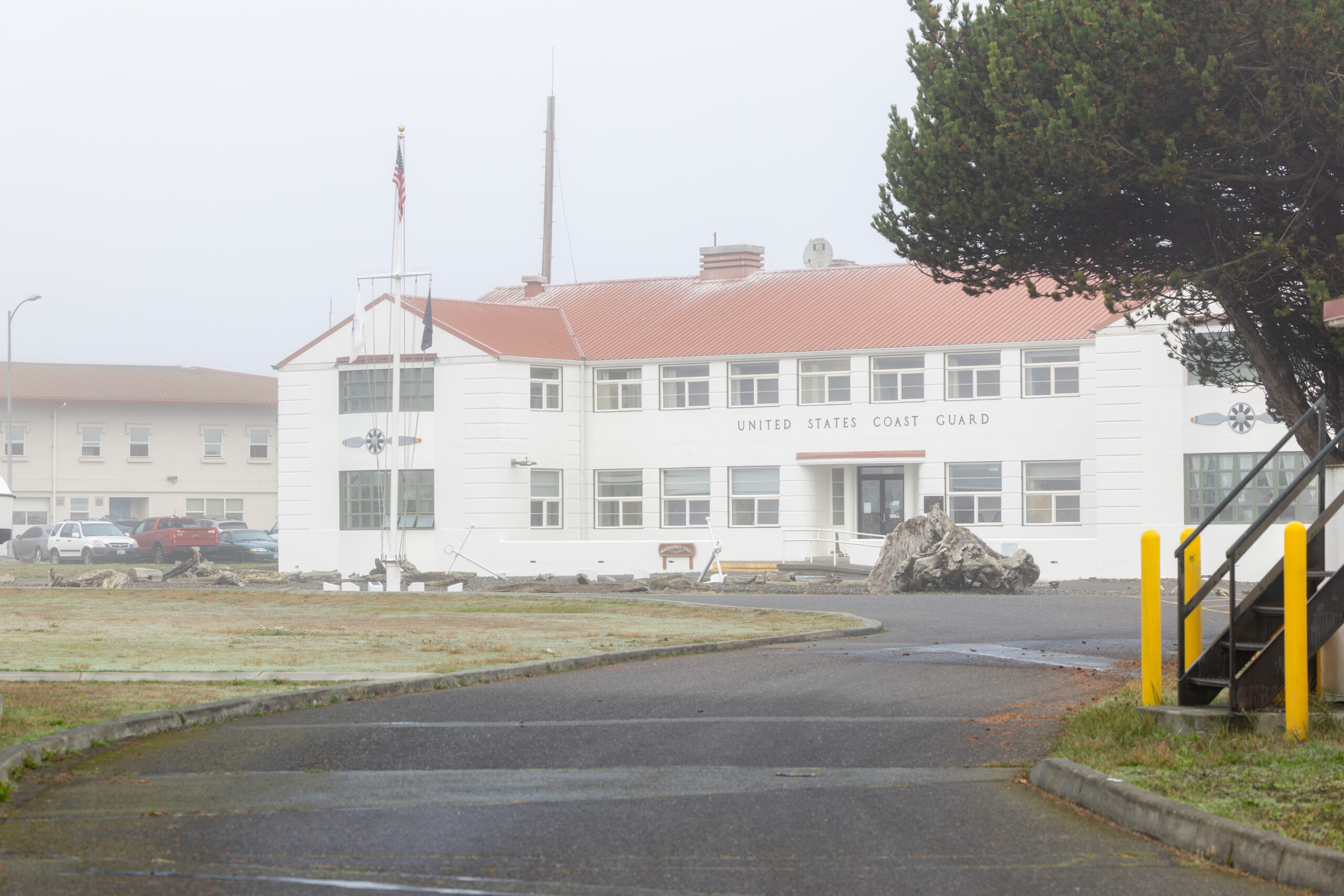
Fog had swallowed Ediz Hook all the way to the water when Lt. j.g. Michael Blunk met me at my truck on Oct. 5. A Coast Guard pilot who spent 13 years in the Army, Blunk began explaining why the helicopter I had come to photograph was staying exactly where it was.
I hold an FAA Part 107 drone certificate, so controlled airspace, weather and flight restrictions were familiar territory. What I learned that morning was another layer, how those rules interact with a Coast Guard crew training in controlled airspace and how the equation changes when that crew is responding to an emergency.
With the clouds below 1,000 feet, the crew needed special clearance from air traffic controllers on Whidbey Island to lift off, and instrument traffic into William R. Fairchild International Airport could keep them waiting. A real emergency was different. As Blunk put it in my original reporting, “We will do what we need to do to get out in time.”
But no life was on the line that morning. The crew would look at the weather again at a quarter past ten.
So we waited.
And because we waited, I started seeing everything I had come for without knowing I had come for it.
The station has a duck with a history of his own.
He is scowling.

The crew calls him the cussin’ duck because he is always wet and irritable. Blunk told me the insignia reaches back to the station’s early years after its commissioning in 1935 under Lt. Carl Bowman. He said Bowman’s brother-in-law drew the duck and had ties to Walt Disney. At some point, the Coast Guard wanted the insignia gone. Port Angeles wanted it back.
The town won.
The duck is still scowling.
Upstairs, the fog pressed against the wardroom windows while Lt. Cmdr. Harry Ehlies, an aircraft commander, explained what 30 minutes means at the oldest Coast Guard air station on the West Coast. Port Angeles has 16 aviators. Larger stations can keep another crew in reserve. Port Angeles cannot. In 2025, its aircrews responded to 116 cases and saved 11 lives.
Looking through those windows at water I could barely see, I asked the question that had been building in my head all morning.
What if a boat were sinking out there right now?
The first answer might not be a helicopter at all. A boat from the station down the road might be the better choice. But if a life, limb or eyesight is at stake, there is no suitable alternative and the crew is reasonably confident its plan will work, Coast Guard regulations allow what they call warranted risk.
The fog could cancel the training flight I had come to photograph.
It would not necessarily have the final word on a rescue.
For training, though, it was winning.

The quarter past ten check came and went, and the crew took me into the hangar.
That was where 30 minutes became physical.
One Dolphin belonged to the next alarm. Another waited behind it as a backup. Deeper in the hangar, a third helicopter had been opened for heavy maintenance, its components exposed while mechanics worked to return it to the rotation.
I asked if I could climb inside, and a flight mechanic took me through the cabin, showing me how the aircraft was built around the work each crew member might have to do.
He showed me his seat and explained how it swings toward the hoist controls when he works the cable. Behind him was the rescue swimmer’s place, where he waits until it is time, as the flight mechanic put it, to “jump out of the helicopter like a badass.”
Up front, I learned there are multiple ways to cut the hoist cable if it becomes snagged. The helicopter carries emergency flotation if the crew ever has to put it down in the water. Rescue gear filled the cabin.
Every seat came with an answer to a question nobody wanted to ask.
What happens if something goes wrong?

Getting the people ready is only half the job. Their helicopters have to be ready too, and these aircraft are more than 40 years old. Salt is the constant enemy. The crews wash them after nearly every flight, fighting corrosion one rinse at a time.
One crew member joked that aviation had taught him why cars do not last as long. Nobody washes a car after every drive.
The same flight mechanics who run the hoist on duty days come back to the hangar on ordinary workdays and turn wrenches.

Then I noticed the figure hanging among the other things the crews had kept.
Life jackets and equipment from past cases covered the wall, some marked with the names of the crews who flew them. Some of the jackets had come off survivors during the ride to a hospital.
The figure looked different.
Battered and marked with what looked like a farewell message, it hung among objects connected to real emergencies. For a moment, I could not tell whether it belonged to that history too.
I studied it before asking the question.
Had someone died?
The answer changed the entire scene.
It was SpongeBob.
The figure was an old rescue-training mannequin, retired when newer ones arrived. The crew had called him SpongeBob, and instead of disappearing when his working days ended, he had found a place on the wall with everything else.
Even the dummy had become part of the station’s history.

But some of the calls Ehlies described carried a different kind of weight.
Before coming to Port Angeles, he told me, he had never been involved in a self-harm case. Since arriving, he had responded to several. He was careful not to offer statistics he did not have. What he wanted me to carry to readers was simpler.
Another number.
Anyone struggling can call or text 988 to reach the Suicide & Crisis Lifeline at any hour.
“Tell someone if you’re having a problem,” Ehlies said.
Down the road, another crew was waiting on the same clock.
At Station Port Angeles, I put my recorder on the table and asked the boat crew where they came from and why they had chosen this life. They sleep at the station between calls, standing 48-hour duty away from home and family.
I once led a crew at a paper mill that ran around the clock. I knew nights, rotating schedules and what it meant to build your life around a clock.
Our shifts were never 48 hours long.
Petty Officer 1st Class Hayden Chapman, a 13-year veteran from Denison, Texas, keeps the station’s two 45-foot and two 29-foot response boats ready. Thirty minutes is their standard too, but they usually do not need it. Five to 10 minutes is typical when a call comes.
The cold makes those minutes expensive.
Even in July, the water off the North Olympic Peninsula rarely climbs out of the 50s.
“Thirty minutes is a big difference with someone in the water,” Chapman said.

The calls can begin with an overturned kayak, an empty boat drifting where someone may have fallen overboard or a person in the water. The aircrews also described medical evacuations and searches that begin with little more than a last-known position.
Then the recorder reached Petty Officer 3rd Class Cole Thompson, a machinery technician from Franklin, Tennessee.
I asked why he joined.
“I had this sense of longing to help people,” he said.
There it was.
Not the helicopter. Not the boat. Not the hoist.
The people.
By noon, I thought I was finally going to get the photographs.
Word came that the helicopter would meet us over the water. I pulled on my raincoat, slipped the cameras into plastic bags and secured them with rubber bands. More than $20,000 in camera equipment was about to go onto the water protected by a few cents of plastic. The boat crew was preparing, and I had already started thinking about where I could stand without getting in the way.
Then someone walked into the room.
“I know you’re all dressed and ready to go,” he said, “but air station just canceled.”
The helicopter had been rolled out. The crews were ready.
The fog did not care.
Blunk offered me another try in the morning. I told him I would be there at 3 a.m. if he needed me.

I came back the next day.
The fog won again.
Four days later, I finally heard the helicopter above me.
This time I was not standing in a hangar waiting for the ceiling to lift. I was aboard a 45-foot response boat in Port Angeles Harbor during a search and rescue demonstration off City Pier for the Dungeness Crab Festival.
Petty Officer 2nd Class Christian Goodrich, an engineer and boarding officer who grew up in Sequim, had walked me through the boat’s controls before the helicopter arrived.
Then the Dolphin came in.
Above us, Lt. Cmdr. Cori Sanchez and Lt. Pete Gaudet flew the aircraft while Aviation Electronics Technician 2nd Class Alexander Kozlov operated the rescue hoist. Beneath them, Aviation Survival Technician 2nd Class Austin Welter moved through water churned by rotor wash before riding the cable back toward the cabin.
Through my cameras, I could finally see the picture I had spent days trying to reach.
But now I knew what was happening outside the frame.
From the boat, I watched a conversation I could not hear.
As a helicopter moves over a pickup point, the pilot flying can lose sight of what is directly beneath the aircraft. The person at the hoist becomes another set of eyes, guiding the helicopter into position with a stream of small corrections.
Blunk had given me the phrase days earlier.
“It’s a dance,” he said. “You never really stop talking.”

My last visit came Oct. 14.
From the edge of the coastal bluff near the Port Angeles transfer station, I watched Welter on the cable again, suspended beneath the Dolphin over the Strait of Juan de Fuca.
One of the pilots holding that hover was Blunk. Lt. TJ Loftis flew alongside him, with Aviation Maintenance Technician 1st Class Chris Tudela, Aviation Maintenance Technician 2nd Class Philip Pezzolanti and Welter completing the five-member crew.
Nine days earlier, Blunk had met me beside my truck while fog hid the water.
Now he was holding a helicopter still above a cliff so another man could hang beneath it.
It took me four trips to photograph what they do.
They get 30 minutes to launch when someone needs them.

My original reporting appeared in the Sequim Gazette as “It’s Go Time,” three words Blunk used when I asked what it is like to wake to that alarm, and in the Peninsula Daily News.
See more photographs from these four days in the Coast Guard Experience gallery.
If you have a story that deserves to be told, I’m available for photography and coverage across the Olympic Peninsula. Book with me.
Captivating Photography
Keep local coverage going
No paywall here and no ads. This site runs on the store. If this post was worth your time, spend a minute in the shop.
Cedar & Shore Studio is my business. It funds this site.